
Remembering America’s first transcontinental road, the Lincoln Highway
Before interstates, before Route 66, there was the Lincoln Highway – America’s “Coast to Coast Rock Highway.” In honor of the 113th anniversary of the dedication of its route on October 31, this post celebrates the diversity of the people and places of Illinois along the highway. Today it is one of two scenic byways in Illinois. The other is Route 66, which marked its centennial this year.
Curious to learn more? Dive into the history of the Lincoln Highway and the sites, individuals, and communities who built the route, promoted its use, and preserved its sense of place and spirit. Check out the Lincoln Highway: The Main Street Across America Story Map here!
By Erica Ruggiero
Affectionately known as the “Father Road,” the Lincoln Highway was conceived in 1912 by automotive entrepreneur Carl G. Fisher as the country’s first transcontinental route. Inspired by the Good Roads Movement and the National Old Trails Road, the Lincoln Highway was the first route built specifically for automobiles. At the beginning of the 1900s, roads were designated by local governments (e.g., cities, townships) and private auto trail associations, resulting in a disconnected and haphazard network of overland routes. In 1912, the United States had over 2.5 million miles of dangerous and mostly dirt roads, which were often bumpy and dusty in dry weather and impassable in wet weather.

 Typical conditions faced by cross-country travelers before the Lincoln Highway. The top photo is near Creston, Ogle County, Ill. The bottom photo is outside of Frankfort, Will County, Ill. (Lincoln Highway Digital Image Collection, University of Michigan)
To complete Fisher's dream of a “Coast to Coast Rock Highway," the Lincoln Highway Association (LHA) was formally incorporated in Detroit on July 1, 1913. The fledgling organization's first efforts focused on identifying the route and fundraising. The LHA developed a preliminary route that bypassed large cities in favor of rural areas to showcase the nation's natural beauty. The route used existing trails and roads, including Native American Trails and early stagecoach routes, as much as possible to minimize the need for grading and planning. The LHA dedicated the official route on October 31, 1913. The highway was dedicated in memory of one of Fisher’s heroes, President Abraham Lincoln, to honor his role in uniting the nation through the creation of a physical connection between communities by way of the highway.
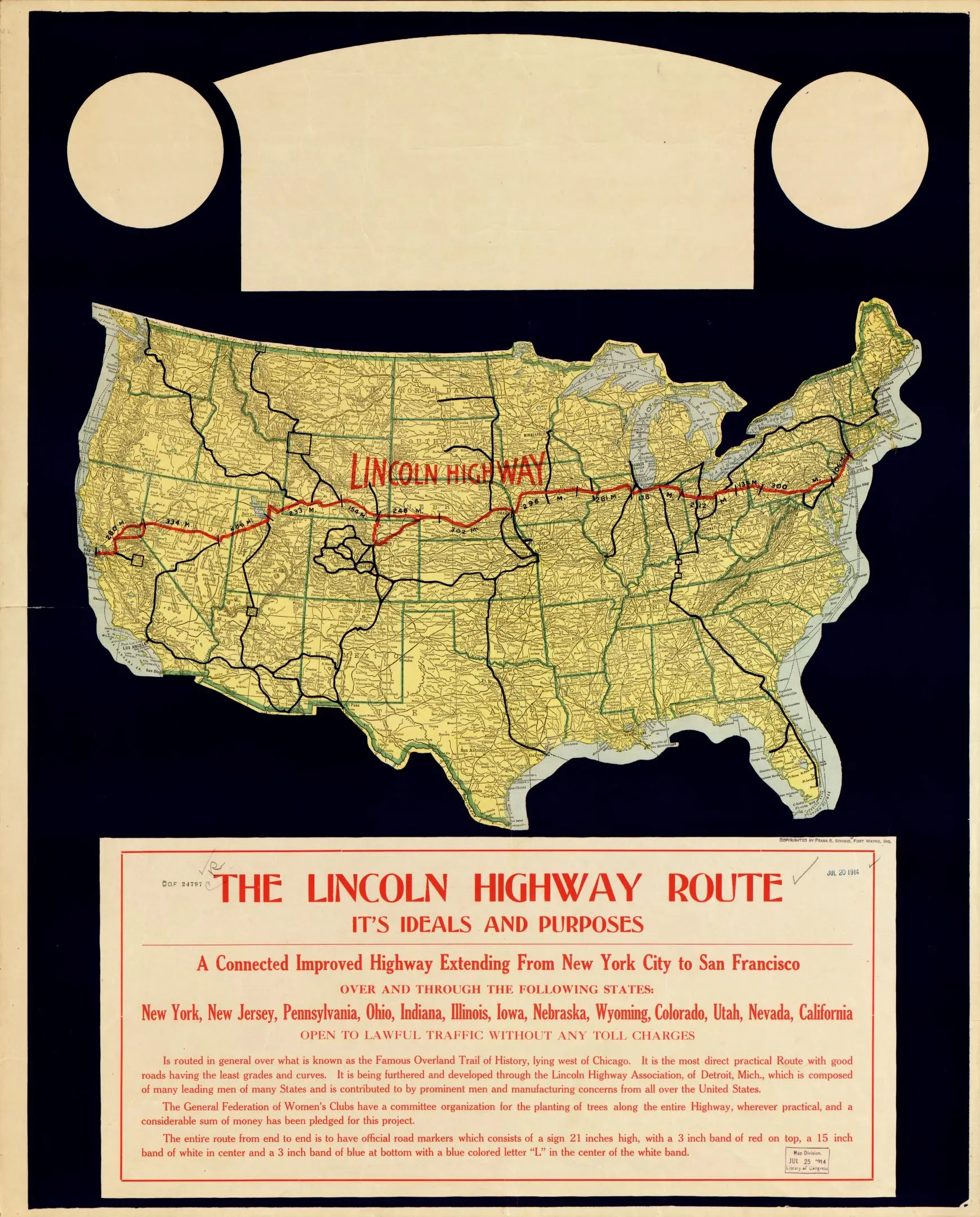 A promotional map for the Lincoln Highway. (Library of Congress)
By using and improving existing roads, Fisher's idea became reality in just two years: the Lincoln Highway crossed nearly 3,400 miles from New York to San Francisco when it was initially completed in 1915. It would be another 11 years before the creation of the U.S. Numbered Highway System, which served as the nation’s first integrated network of roads and highways numbered within a nationwide grid.
Illinois has the honor of being the first state to complete its segment of the Lincoln Highway through the dedication and hard work of the communities along the route. Due to a lack of public funding, individuals and communities funded and undertook the physical construction of the Lincoln Highway. In turn, the highway provided an economic boost to the communities located along the route, earning it the nickname “The Main Street of America.” The Lincoln Highway assisted in the diversification of the state's predominantly agricultural and industrial economies.
Public support for the “rock highway” was catalyzed by the development of the “Seedling Mile” to demonstrate the value and practicality of the road improvements. Each “Mile” was paved with concrete along the Lincoln Highway route. They were typically constructed in rural communities, which were plagued by muddy, unmaintained dirt roads and would benefit from the installation, which, in turn, would promote road improvements.
The first Seedling Mile in the nation was completed in October 1914 in the farming community of Malta, DeKalb County, Illinois. Citizens of Malta, the LHA, and the Marquette Cement Company built the mile through a combined effort, also marking one of the first uses of concrete for road surfacing in the United States. With the successful installation of Seedling Miles, the Lincoln Highway was further propelled through the donation of millions of barrels of cement by several companies, including Lehigh Portland Cement and Marquette Cement.
 The 10-foot-wide “seedling mile” at Malta, Ill. (Lincoln Highway Digital Image Collection, University of Michigan)
After the Lincoln Highway was completed in 1915, support for federally funded and constructed roads shifted positively. A significant milestone for better roads was the passage of the Federal Aid Road Act of 1916. It established the Federal-Aid Highway Program, which provided federal subsidies for road construction and assigned a highway agency to each state for the first time in the nation's history. However, America’s entry into World War I in April 1917 diverted funds and materials, stalling the program.
In 1926, the LHA realized the substantial completion of the Lincoln Highway. That same year, the U.S. Numbered Highway System was established, incorporating a significant portion of the Lincoln Highway into U.S. Route 30. Having formally achieved the organization's core mission, the LHA disbanded on December 31, 1927.

 Examples of completed sections of the Lincoln Highway. The top photo is in Whiteside County near the
Mississippi River in northwestern Illinois. The bottom photo is in Cook County. (Lincoln Highway Digital Image Collection, University of Michigan)
The growth of highway improvement programs slowed during the Great Depression and World War II. In 1947, President Harry S. Truman hosted the Presidential Highway Safety Conference, urging the prioritization of highway safety. Truman's advocacy led to the Action Program, which created a Uniform Vehicle Code and Model Traffic Ordinance, introduced traffic education in schools, strengthened traffic laws, improved highway design, and developed licensing programs.
President Dwight D. Eisenhower championed the nation's Interstate Highway System by supporting the Federal-Aid Highway Act of 1956. The act funded 40,000 miles of limited-access interstate highways nationwide. These highways differed from the Lincoln Highway and U.S. Numbered Highway System, as the network was composed of uniform, controlled-access highways designed for high-speed traffic, with all ingress and egress traffic regulated. As the Interstate Highway System was built, travelers bypassed the Lincoln Highway and the small, rural communities along the way for faster, more direct routes.
In 1991, the Intermodal Surface Transportation Efficiency Act laid the groundwork for the National Scenic Byway and All-American Road programs, which recognize outstanding examples of scenic, historic, recreational, cultural, archaeological, and natural beauty along the nation's roadways. In Illinois, the state chapter of the Lincoln Highway Association submitted the route to the Federal Highway Administration for designation as a National Scenic Byway. The Illinois segment of the Lincoln Highway, composed of 178.8 miles, is the first and only section to receive this designation in its entirety.
Ruggiero is a principal with the historic preservation architecture firm of McGuire Igleski & Associates (MIA). MIA in partnership with Heritage Corridor Destinations worked to document the history and built environment associated with the Lincoln Highway in Illinois. The project was generously funded by a Bureau of Planning Grant from the Illinois Department of Transportation. She and Associate Historic Preservation Specialist London Hainsworth discussed their work at the 28th Conference on Illinois History.

 Postcards showing the Lincoln Highway in the Blue Ridge Mountains of Pennsylvania and next to the Green River in Wyoming. (Newberry Library)
Legal Disclaimer:
EIN Presswire provides this news content "as is" without warranty of any kind. We do not accept any responsibility or liability for the accuracy, content, images, videos, licenses, completeness, legality, or reliability of the information contained in this article. If you have any complaints or copyright issues related to this article, kindly contact the author above.
